

The New Space Race: Investing Beyond Earth
A Growing Economic Frontier
Space is no longer just about astronauts and moon landings. Over the past decade, private companies have transformed the industry into a rapidly growing commercial market. The global space economy was valued at approximately $630 billion in 2023 and is projected to reach $1.8 trillion by 2035. This has been made possible by key advances in communications, earth observation, transportation technologies, climate monitoring, digital infrastructure, and defense.
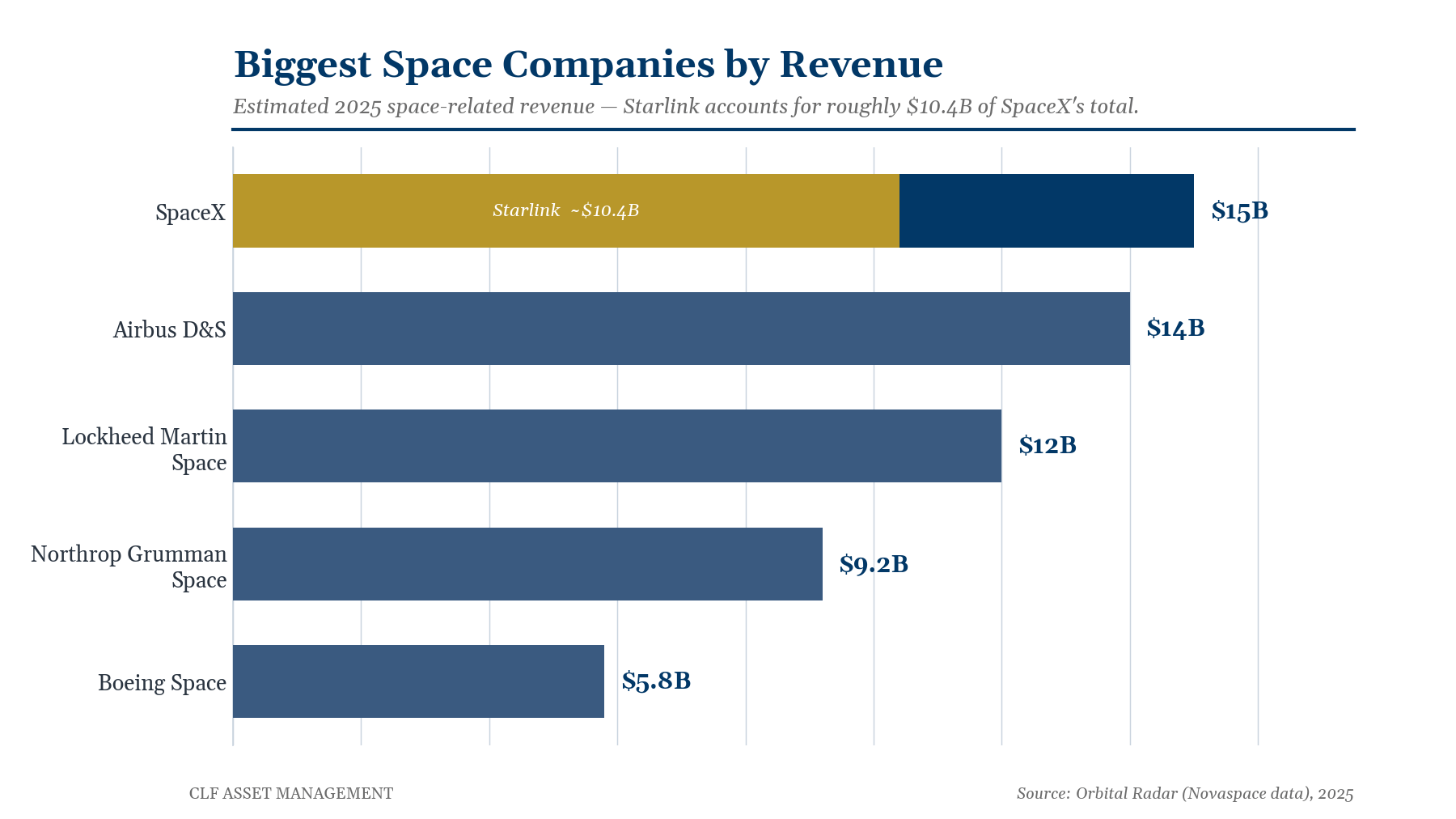
Orbital Radar
(Novaspace data).
A Major Milestone for SpaceX
One of the biggest developments in the space industry this year was the highly anticipated public debut of SpaceX. The company completed the largest IPO in history, raising approximately $75 billion and valuing the company among the world’s largest at $1.8 trillion. SpaceX’s successful public offering demonstrates the increasing commercial demand for space-related services and may help pave the way for other private companies to access public markets.
From Old Space to New Space: Who Leads Exploration
The traditional “old space” model was driven primarily by national governments and public agencies such as NASA, ESA, and other state-funded organizations, which oversaw research, engineering, launch capabilities, and the development of critical space infrastructure. The new space economy operates differently. Several companies are helping drive the next phase:
- SpaceX — Dominant launch provider and operator of the Starlink satellite network
- Blue Origin — Jeff Bezos-backed space company focused on launch services
- Rocket Lab — Growing provider of satellite launches and space systems
- Intuitive Machines — Pioneer in commercial lunar exploration and technology
- Planet Labs — Provides satellite imagery and data for businesses and governments
- Lockheed Martin — Major aerospace and defense contractor
Private Capital Investment Trends
- Earth observation and climate intelligence
- Satellite communications infrastructure
- AI-powered space data analytics
- Launch services and reusable systems
- In-orbit servicing and debris management
- Defense and cybersecurity technologies
- Autonomous navigation systems
- Space manufacturing and robotics
Where Value Is Created in a Trillion-Dollar Space Economy
Shift from selling space assets to providing outcome-based services
- Space companies are competing to deliver recurring services such as connectivity, intelligence, and monitoring rather than just launching software
- Buying into solutions instead of operating complex hardware reduces upfront capital costs and accelerates time to value for investors
Sovereignty is becoming a long-term driver of demand
- Governments, alliances, and businesses are seeking greater control over infrastructure
- Ongoing investments in cybersecurity, upgrades, maintenance, and system resilience are driving long-term growth
Commercial space companies are operating faster than government agencies
- Lower launch costs, shared launch economics, miniaturization, software-driven development, and specialized supply chains
Value Chain of the Space Economy
| UPSTREAM | MIDSTREAM | DOWNSTREAM |
|---|---|---|
| Launchers, satellite production, and propulsion | Low, medium, and geostationary satellite operators | Connectivity, earth observation, navigation, and defense |
Emerging Opportunities
Orbital construction and in-space manufacturing
Building satellites, space stations, and infrastructure in orbit while producing high-value materials
Lunar resource extraction
Mining water ice and other resources to produce fuel, oxygen, and construction materials
AI and robotics
Enabling satellite servicing, autonomous spacecraft, and robotic exploration
Space-based energy production
Continuous power for operations using solar power generation and wireless energy transmission
Launch services and rideshare
More frequent, lower-cost launches combined with orbital transportation, refueling, and cargo delivery
Satellite servicing
Refueling, repairing, upgrading, and extending satellite life
Space data analytics
Earth observation, communications, positioning, weather, and climate monitoring — driving value into industries like agriculture, insurance, energy, finance, and defense
Questions about how these themes fit into your portfolio?
Reach out to your CLF advisor — we’re always happy to talk through what’s on your mind.
Published July 13, 2026
This material is provided by CLF Asset Management for informational and educational purposes only and does not constitute investment advice or a recommendation to buy, sell, or hold any security, including any company mentioned herein. Mentions of specific companies are for illustrative purposes only. Market values, valuations, and projections are estimates drawn from third-party sources believed to be reliable but not guaranteed, and are subject to change. Investing involves risk, including possible loss of principal. Past performance is not indicative of future results. Please consult your advisor regarding your individual circumstances.